What anaesthesia is
The word anaesthesia means "loss of sensation". It describes the use of medicines to prevent you from feeling pain during a procedure. Depending on what you need, anaesthesia may numb a small area, numb a larger part of your body, help you relax and feel drowsy, or place you in a carefully controlled deep sleep.
Anaesthesia is temporary and reversible. The medicines are given in carefully measured doses and adjusted moment by moment. When they are reduced or stopped, their effects wear off. The main approaches are explained on Types of Anaesthesia.
Your specialist anaesthetist
In Australia, a specialist anaesthetist is a medical doctor who has completed a medical degree, a period of general hospital work, and then at least five years of specialist training in anaesthesia through the Australian and New Zealand College of Anaesthetists (ANZCA). Training covers anaesthesia for every kind of surgery, the medicine of the heart, lungs and other organs, pain management, resuscitation and the care of seriously unwell patients.
Doctors who complete this training and its examinations become Fellows of ANZCA, shown by the letters FANZCA. Specialist anaesthetists also take part in continuing professional development throughout their careers.
My own clinical work includes anaesthesia for neurosurgery, interventional radiology, vascular, orthopaedic and endocrine surgery, and for patients with complex medical conditions. You can read more on About Me.
Before your procedure
Good anaesthesia begins well before the day of surgery. Before your procedure I will review your health, including your heart and lungs, any other medical conditions, your medications and allergies, and any previous operations and anaesthetics. You will usually be asked to complete an anaesthetic questionnaire, which helps me prepare.
For some people, particularly those having major surgery or living with significant medical conditions, I may arrange tests, seek information from your other doctors, or use formal risk-assessment tools to understand your individual risks. I will then talk with you about the anaesthetic I recommend, its benefits and risks, and any reasonable alternatives. That conversation is described on Understanding Your Anaesthetic & Informed Consent.
Practical advice on getting ready, including fasting, is on Preparing for Your Procedure.
During your procedure
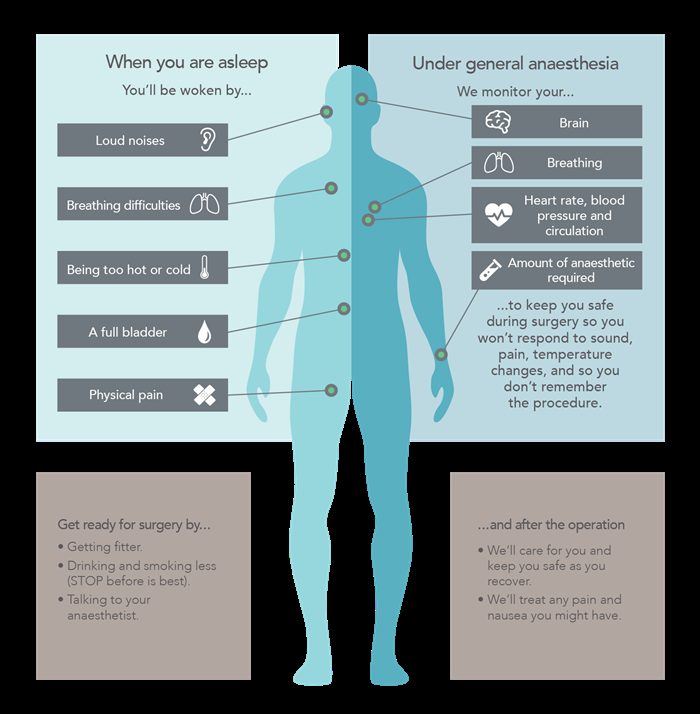
Your anaesthetist gives the anaesthetic and then stays with you for the whole procedure. Throughout, their attention is on you: your breathing, circulation, temperature, fluid balance, comfort and depth of anaesthesia. They give medicines and fluids as needed, respond to changes as the operation progresses, and plan your pain relief for afterwards.
If you are having a general anaesthetic, your anaesthetist looks after your breathing, often with a small device placed in your mouth or throat once you are asleep. If you are awake or sedated, they are with you to keep you comfortable, answer questions and adjust your medicines.
How you are monitored
Modern monitoring lets your anaesthetist see, continuously and in real time, how your body is responding. Standard monitoring for an anaesthetic includes:
- Heart rhythm, using small sticky pads on your chest (ECG).
- Oxygen levels, using a clip on your finger (pulse oximetry).
- Blood pressure, with a cuff on your arm that inflates regularly.
- Breathing and carbon dioxide, measuring the gases you breathe in and out (capnography).
- Temperature, particularly for longer procedures.
- Depth of anaesthesia, where appropriate, using a sensor on your forehead that analyses brain activity.
For some major procedures, additional monitoring may be used, such as a fine tube in an artery to measure blood pressure with every heartbeat. If this is likely for you, I will explain it beforehand.
After your procedure
When your procedure is finished, your anaesthetist reverses or stops the anaesthetic and accompanies you to the recovery room. Specialist recovery nurses then care for you closely while you wake up, with your anaesthetist available throughout. Your anaesthetist also oversees your pain relief, treats any nausea, and decides when you are ready to leave recovery.
More detail is on Recovery & Aftercare.
Working as a team
Your anaesthetist works closely with your surgeon or proceduralist, anaesthetic and theatre nurses, technicians and recovery staff. Before your procedure the team checks your identity, the planned procedure, your consent and your allergies together. During the procedure the anaesthetist and surgeon communicate continuously. Afterwards, your care is handed over carefully to the recovery and ward teams.
Teamwork and clear communication are central to safe care. You are part of that team too: telling us about your health, asking questions and sharing your concerns all help.
Further reading
- What is anaesthesia? (ANZCA)
- What does an anaesthetist do? (ANZCA)
- Anaesthetics (overview) (Healthdirect)