Your pre-anaesthetic assessment
Before your procedure you will usually be sent an anaesthetic questionnaire about your health. Please complete it carefully and return it as early as you can. It helps me identify anything that needs attention well before the day, rather than on the morning of surgery.
Depending on your health and your procedure, I may then speak with you by phone, see you in consultation beforehand, or meet you on the day. For major surgery, or if you have significant medical conditions, an earlier consultation gives us time to arrange tests, gather information from your other doctors and plan your care together. You will also receive information about anaesthetic fees, explained on Fees & Accounts.
What to tell your anaesthetist
The more I know about your health, the better I can plan. Please tell me about:
- Medical conditions, especially heart or lung disease, high blood pressure, diabetes, sleep apnoea, reflux, kidney or liver disease, neurological conditions, and any bleeding or clotting problems.
- Previous anaesthetics, including any problems such as severe nausea, difficulty waking, a reaction to a medicine, or being told your airway or breathing tube was difficult.
- Family history of serious problems with anaesthesia, which can occasionally point to an inherited condition.
- Allergies to medicines, latex, antiseptics, adhesive tape or foods, and what happened when you reacted.
- Loose, capped or crowned teeth, dental implants or bridges.
- Pregnancy, or the possibility of pregnancy.
If anything changes between completing your questionnaire and your procedure, please let the hospital or the practice know.
Your medications
Please give me a complete, up-to-date list of everything you take: prescription medicines, over-the-counter medicines, vitamins, herbal and other supplements, and any recreational drugs. Some medicines, including blood thinners, diabetes medicines and GLP-1 or other weight-loss medicines, need particular planning before anaesthesia.
Fasting before your anaesthetic
When you are anaesthetised or deeply sedated, the reflexes that normally protect your lungs are reduced. If there is food or fluid in your stomach, it can come back up and enter the lungs. This is called aspiration. It is uncommon, but it can cause a serious lung infection, and rarely it can be life-threatening. Fasting reduces the amount in your stomach and so reduces this risk.
Current ANZCA guidance, updated in 2024, has made fasting for most adults shorter and more comfortable than in the past. In general terms, for most adults having a planned procedure:
- Food: you can usually eat until about six hours before your anaesthetic. This also applies to milk, and to tea or coffee with milk. Avoid a large or fatty meal the night before.
- Clear fluids: many hospitals now use an approach called "Sip Til Send". This allows small amounts of clear fluid, up to about 200 mL (roughly half a cup) an hour, until you are called to theatre.
- Clear fluids include water, pulp-free clear juice such as apple juice, clear cordial, black tea or coffee without milk, and clear carbohydrate drinks. Milk, plant-based milks, broth, jelly and drinks with pulp or fibre do not count as clear.
- Chewing gum and lollies should be discarded when you arrive at hospital.
Unless you have been told otherwise, you can usually take your regular morning medicines with a small sip of water.
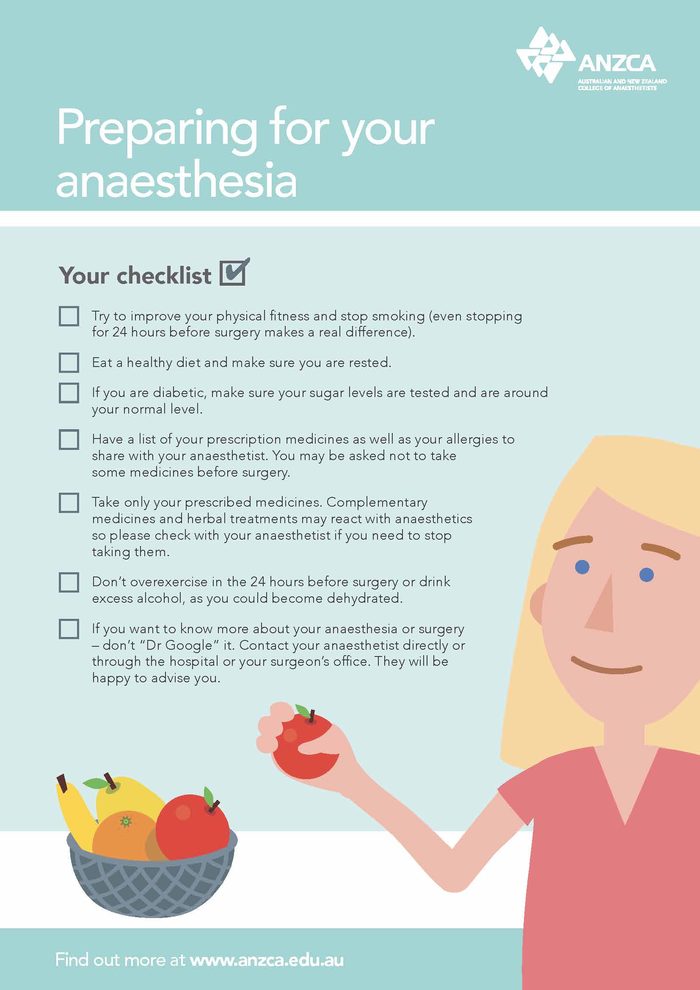
Looking after your health beforehand
Smoking and vaping. Stopping smoking before surgery helps your heart and lungs, reduces breathing complications and helps wounds heal. Stopping several weeks beforehand gives the greatest benefit, but even a day or two without smoking helps. Vaping also affects the lungs, so it is worth stopping or reducing it too. Your GP or Quitline can help.
Alcohol. Please avoid alcohol for at least 24 hours before your procedure. If you drink regularly or heavily, tell me honestly, as stopping suddenly can cause problems that are best planned for.
Recreational drugs. These can interact with anaesthetic medicines. Telling me is confidential and helps keep you safe.
Staying active. Where you are able, keeping active and eating well in the weeks before surgery can help your recovery.
If you become unwell before your procedure
A cold, flu, COVID-19 or another infection in the days before surgery can increase the risk of breathing complications under anaesthesia. If you develop a fever, cough, new breathing difficulty or a stomach upset, please contact the hospital or your surgeon's rooms as early as possible. Sometimes it is safest to postpone a planned procedure. A mild runny nose without fever is often not a reason to postpone, but this is a decision best made together.
Practical preparation
- Clothing: wear loose, comfortable clothes that are easy to put on afterwards, especially if you will have a bandage, sling or brace.
- Jewellery and piercings: please remove them before you come in, or ask the hospital for advice if something cannot be removed. Wedding rings can usually be taped.
- Make-up and nail polish: please remove make-up, and nail polish or gel from at least one finger on each hand, so that the oxygen monitor on your finger can read accurately and staff can see your skin colour.
- Contact lenses should be removed before your procedure. Bring your glasses and a case.
- Dentures, hearing aids and glasses: bring them with you. Hearing aids and glasses can often stay in until just before your anaesthetic, which helps you communicate with the team. Bring a labelled container for each.
What to bring
- Your medicines in their original packaging, or an up-to-date list.
- Your Medicare card and private health insurance details.
- Any letters, test results or imaging you have been asked to bring.
- Your CPAP machine if you use one for sleep apnoea.
- Something to read, and a phone charger if you expect to wait.
Please leave valuables at home.
Getting home after day surgery
Anaesthetic and sedation medicines can affect your judgement, reactions and balance for up to 24 hours, even when you feel well. If you are going home on the same day, please arrange in advance for a responsible adult to collect you, take you home and stay with you overnight. You should not drive yourself or travel home alone on public transport. If you cannot arrange this, please let the hospital know beforehand, as your procedure may need to be rescheduled or an overnight stay arranged.
More on the first 24 hours is on Recovery & Aftercare.
Further reading
- Preparing for your operation (ANZCA)
- Fasting before your surgery (ANZCA)
- Sip Til Send fluid fasting (Safer Care Victoria)