The articles
Ellard L, Higgs A, Cooper RM, et al. Project for Universal Management of Airways: guidelines for tracheal extubation. Anaesthesia 2026.1 doi:10.1111/anae.70365
Ahmad I, Cook TM. PUMA tracheal extubation guidelines: towards clarity or complexity? Anaesthesia 2026 (editorial).2 doi:10.1111/anae.70436
What the papers say
Extubation has never received the attention given to intubation, yet adverse events after extubation are more likely to end in brain injury or death, and many follow inadequate planning. The Project for Universal Management of Airways (PUMA), an international group of 15 airway experts, has now published guidelines intended for any discipline, any patient group and any setting.1
Their central message is that extubation warrants the same evaluation, strategy, preparation and vigilance as intubation. Risk is assessed in terms of hypoxaemia, pulmonary aspiration and harm from airway stimulation. The assessment considers the patient's baseline risk, anything that has changed since intubation, and team and situation factors. If restoring an airway after extubation would not be "rapid and reliable", the extubation is designated "at risk".
Planned extubation is always elective. It should be deferred when deferral will genuinely reduce risk, but not otherwise, and timed to avoid shift changes. Quantitative neuromuscular monitoring is recommended. When the margin of safety is thin, awake extubation over an airway exchange catheter is recommended. Converting between airway devices over a continuous guide is preferred to removing one device and inserting another.
In the accompanying editorial, Ahmad and Cook acknowledge the scholarship and accuracy of the guidelines, but question whether another guideline is needed alongside those of the Difficult Airway Society and others.2 They suggest it could be a third shorter, with fewer branching algorithms and fewer new terms, and note some omissions, including gastric ultrasound, capnography after extubation and lung recruitment before it.
What is valuable
- It treats extubation as a planned procedure with its own strategy, rather than simply the end of an anaesthetic.
- It links risk assessment to a specific approach, with airway rescue planned before the tube is removed.
- It recognises that the patient at the end of surgery may be quite different from the patient at induction, because of bleeding, swelling, positioning or fixation.
- Its practical advice on airway exchange catheters, laryngospasm, aspiration and extubation technique is detailed, well referenced and genuinely useful.
- It applies to adults and children, and to theatre, the emergency department and intensive care.
What to bear in mind
- It is long. It reads less like a bedside algorithm and more like a well-written textbook chapter by people who clearly enjoy the subject. That is a strength for learning, but it will need distilling for use at the bedside.
- Its recommendations rest largely on expert consensus. Problems after extubation are common, but high-quality evidence to guide individual decisions remains limited, and the ongoing international EXTUBE study should help fill that gap.
- Its relationship with national guidelines, including the forthcoming Difficult Airway Society update, will need to be worked through locally.
- The editorial authors declare their own interests. Ahmad is the immediate past President of the Difficult Airway Society, and Cook attended PUMA's first meeting.
My commentary
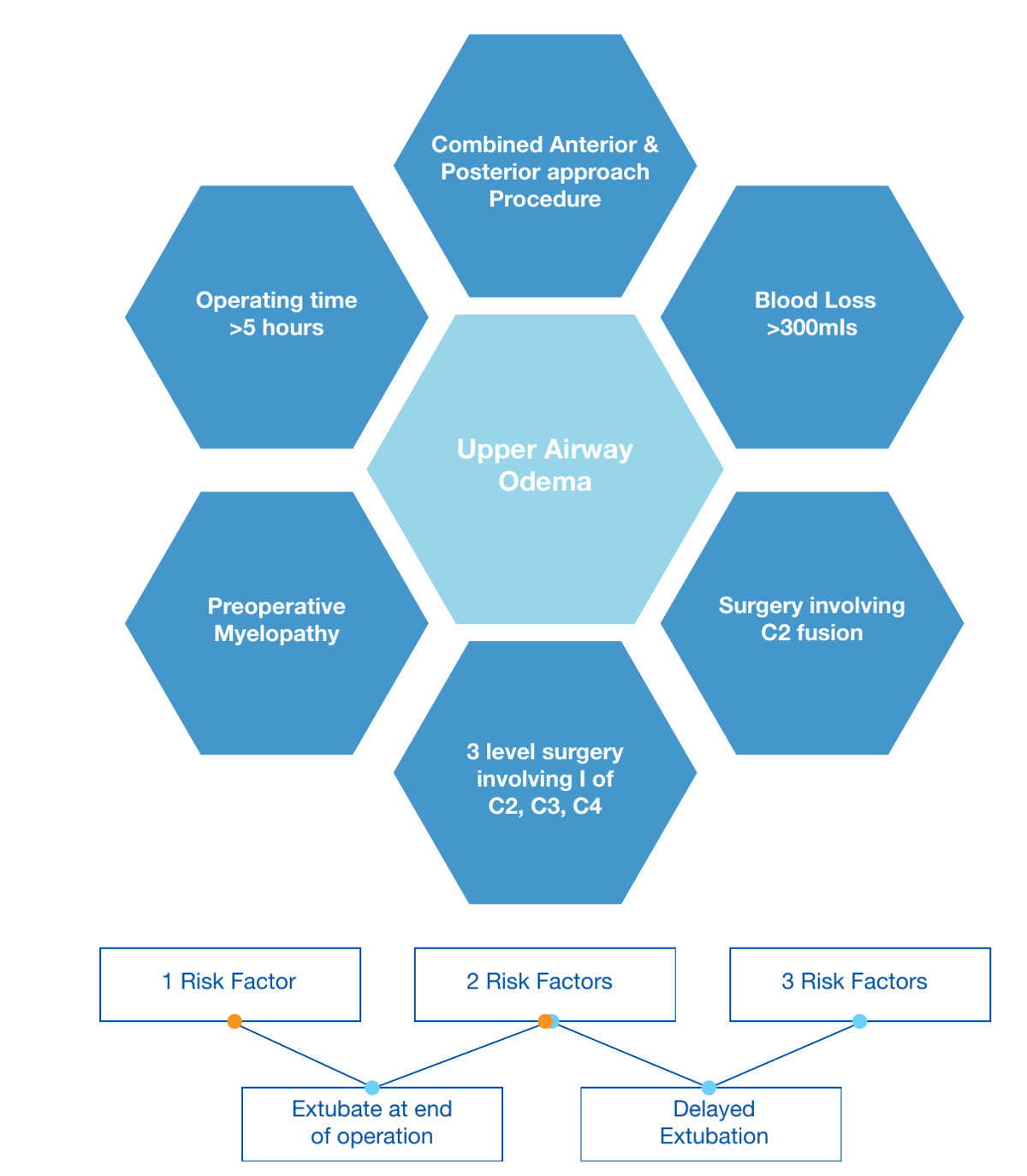
I enjoyed these guidelines, and not only because they cite our work. In 2017, with colleagues from The Alfred and the Airway Management Special Interest Group, I co-authored a review of airway management after cervical spine surgery in Australasian Anaesthesia, which included an extubation protocol and a cognitive aid.3 PUMA draws on it in discussing how bleeding and swelling progressively distort the airway after intubation, and how fixation or a halo brace can make rescue harder than the original intubation.
Those patients illustrate almost every principle PUMA sets out. Postoperative upper airway oedema after cervical spine surgery is predictable but easily missed, and prevertebral swelling typically peaks around the third day, not in recovery. We identified risk factors including a combined anterior and posterior approach, surgery lasting more than five hours, blood loss over 300 ml, involvement of C1, C2 or three or more levels, myelopathy and pre-existing lung disease. For high-risk patients we recommended delayed extubation, a cuff leak before extubation, extubation over an airway exchange catheter, and close monitoring for warning signs such as voice change, difficulty swallowing and stridor. We also found that none of the Victorian centres we surveyed had a protocol. It is very satisfying to see these principles now carried into international guidance.
Australian guidance has made the same point for some time. The ANZCA Airway Assessment resource sets out nine core considerations for every airway assessment, ending with "How easy will they be to extubate safely?"4 Among its principles for difficult airway equipment is that successful intubation should be followed by successful extubation, with tube exchange catheters available. The PS61 cognitive aid on evolving airway obstruction carries the same question into its airway assessment and planning checklist: "Is there an extubation risk?"5 In other words, extubation risk belongs at the start of the anaesthetic, not only at the end. That is exactly PUMA's point about baseline risk.
One recommendation deserves particular attention, because it challenges a common habit. PUMA advises a sustained inflation of the lungs to near vital capacity immediately before deflating the cuff, with positive pressure maintained as the tube is removed. This reverses atelectasis and reduces laryngeal excitability. It also produces a passive exhalation that helps clear soiling above the cuff, and leaves a larger oxygen reservoir if obstruction follows. Conversely, applying suction down the tracheal tube as it is removed is discouraged, because it promotes atelectasis and depletes that reservoir.1 I have always extubated on positive pressure, and I have never liked watching a suction catheter run down the tube as it comes out. Suction the airway beforehand if needed, re-oxygenate, then remove the tube on a breath in, not on a vacuum.
The guidelines also bear on a question I raised in a recent commentary on extubation location: whether moving emergence to recovery saves time or simply moves risk. PUMA accepts removal of a supraglottic airway in recovery by appropriately skilled staff, provided an airway operator remains immediately available. It considers deep exchange of a tracheal tube for a supraglottic airway useful in selected patients, but not when aspiration risk is increased or extubation is otherwise at risk.1 That is a clinical indication, not a scheduling one.
Ahmad and Cook make a fair point about length, but I would read PUMA the way one reads a good textbook: once, properly, and then distil it. For most patients the essentials fit on a card. Assess extubation risk at the start. Reassess what has changed by the end. Decide whether extubation is at risk. Plan the rescue before you remove the tube. Have the right people present. Extubate on positive pressure. If the margin is thin, leave a guide in the trachea. The rest of the detail is there for the minority of patients in whom it really counts, and for those of us who enjoy the subject.
Extubation is not the end of airway management. It is the start of the most dangerous part of recovery.
References
- Ellard L, Higgs A, Cooper RM, et al. Project for Universal Management of Airways: guidelines for tracheal extubation. Anaesthesia 2026. doi:10.1111/anae.70365
- Ahmad I, Cook TM. PUMA tracheal extubation guidelines: towards clarity or complexity? Anaesthesia 2026. doi:10.1111/anae.70436
- Nicholson JJ, Bradley WPL, Stefanutto T, Downey GO, Berkow L. Airway management after cervical spine surgery: a review of the literature. In: Australasian Anaesthesia 2017. Melbourne: Australian and New Zealand College of Anaesthetists, 2017: 13–20.
- Bradley P, Chapman G, Crooke B, Greenland K. Airway Assessment. Melbourne: Australian and New Zealand College of Anaesthetists, 2016. ANZCA (PDF)
- Australian and New Zealand College of Anaesthetists. PS61 Guideline for the management of evolving airway obstruction: transition to the Can't Intubate Can't Oxygenate airway emergency. Cognitive aid: supplementary information. Melbourne: ANZCA, 2016.
This commentary is my own professional opinion, written for anaesthetists and other professional readers. It does not represent Alfred Health, ANZCA or any other organisation with which I am associated, and it is not individual medical advice. The original articles are the work of their authors and are linked above.